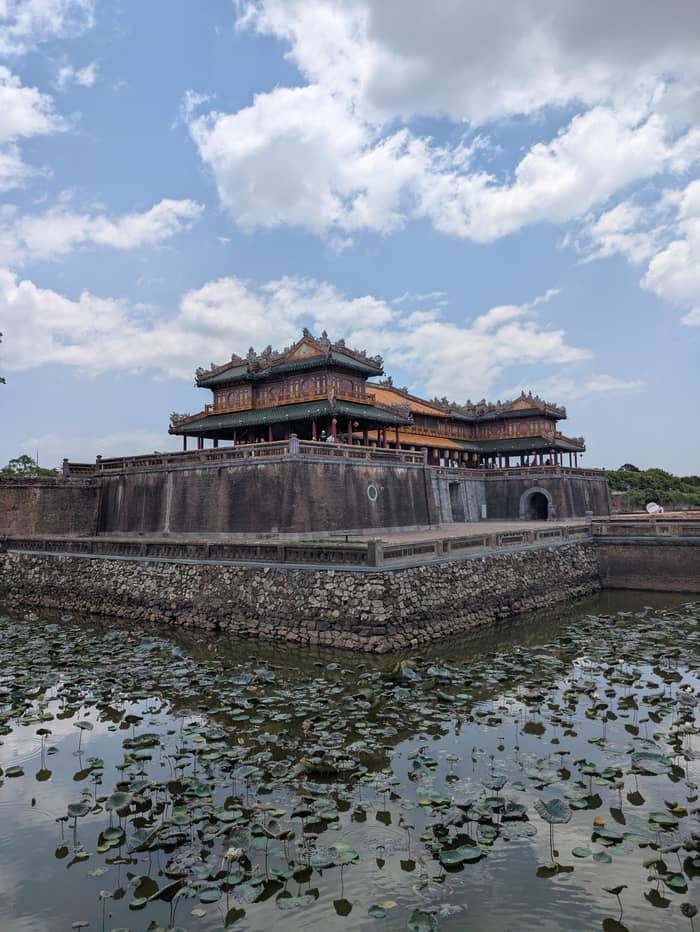
2.5 hours
Guided walk of the walls
Gate, hall, palace and theater
- Walk2.5 hours
- GuideEnglish, French
- Reviews317
Guides
Language
Currency
See availabilityfrom $49 · no cancel feeCost for your party
Compare 4 side by side
Choose your party and read the price of each way to hear the story.
≈
View≈
View≈
View≈
ViewAll amounts are from-prices on GetYourGuide, converted at the ECB reference rate. Exact prices are shown at booking.
From the first Nguyen king who moved his capital to Hue to the World Heritage listing and today's restoration, read through the halls, urns and tombs you can still walk.
Editorial team, hueimperialcitytour.click · Updated November 16, 2026 · A 7 min read
Basics
The story of the Hue Imperial City starts with a decision about geography. The story starts with Gia Long, the first Nguyen king, who according to the national tourism authority shifted the seat of government from Hanoi to Hue and set the citadel's construction going.1 Along the Perfume River, the same source adds, the emperors raised offices, army headquarters, palaces, temples and their own tombs.6 A capital on a river, reached from the sea, suited a dynasty that wanted both court and defense in one place.
The tourism authority sums up the span in one figure: the last royal dynastic family reigned for 143 years, and what survives of that reign is the citadel and the tombs.2 Hue's last emperors lived in a Vietnam changed by French power, and the authority notes the Nguyen Dynasty ended in 1945.3 For a visitor, those dates give you an arc. The citadel was begun by a conqueror and finished in the years when the court's real power was shrinking.
The setting explains the plan. The authority points to Beijing's Forbidden City as the model and says the layout follows a cosmology built from five elements, directions and colours.7 The central axis is that belief drawn in stone. The map of the city is also a statement about how the court understood the world, and a visitor who knows the logic can read the layout much more quickly and place each hall in the order it was meant to be approached.
A ledger of the Nguyen sites
| Place | What is dated | Source says |
|---|---|---|
| Thai Hoa Palace | Built and moved | 1805 and 18338 |
| Nine Dynastic Urns | Cast | 18369 |
| Gia Long tomb | Completed | 182010 |
| Minh Mang tomb | Completed | 184311 |
| An Dinh Palace | Built | 191712 |
| Thien Mu tower | Built | 184417 |
| Hue citadel | UNESCO listing | 19934 |
Dates as the Hue city portal and the national tourism authority give them; a construction date and a completion date can differ for the same site.8
Hue Imperial City facts are easiest to hold when you start at Thai Hoa Palace, the best place to read the dynasty's history, because the court itself rebuilt it once and left the dates behind. In the portal's words, 13 Nguyen emperors held their coronations there, and it went up in 1805 under Gia Long before Minh Mang relocated it in 1833.8 The building you see is therefore the result of a second decision, taken by Minh Mang, to give the throne hall its present position.
What happened in that hall is described in an old account republished on the same portal. The writer saw a lacquered and gilded throne raised on 3 steps, with 2 tigers carved at its foot, and notes that officials and servants removed their shoes and kept their voices low near the emperor.13,14 That picture of ritual silence fits the architecture the account describes: a large roof, red and gold lacquered columns, and a courtyard where the court stood outside.
The hall has also been the focus of modern conservation. A restoration that began in 2021 cost 129 billion VND and used 3D scanning to record the existing components before anything was dismantled.5,15 The portal adds that the palace holds poems and pictures in the one-poem-one-painting style, which carry a UNESCO listing of their own under the regional Memory of the World register.16 If you visit, ask at the gate about the state of the hall, because the portal's account describes work that was still under way.
The dynasty in order
Capital moved
The first Nguyen king moved the capital to Hue and began the citadel.1
Throne hall
It was built in 1805 and relocated in 1833 under Minh Mang.8
Urns cast
The urns were cast in 1836 under Minh Mang.9
Tombs finished
The Gia Long tomb was completed in 1820 and Minh Mang's in 1843.10,11
Late dynasty
An Dinh Palace was built in 1917 under Khai Dinh.12
End and listing
The dynasty ended in 1945, and the citadel was listed in 1993.3,4
The ancestral temples are where the dynasty preserved its memory. Four principal ancestral temples flank the Courtyard, and a detached temple, Phung Tien, stands behind them.22 In the courtyard of The To Temple stand the Nine Dynastic Urns, which the portal says were cast in 1836 under Minh Mang, with Cao Dinh, the largest, in front of the temple courtyard.9,23 They are the bronze record of the dynasty.
The state has since recognized their worth. The portal says the Nine Dynastic Urns were recognized as a National Treasure in 2013.20 That makes the urns a rare case where a piece of the court's furniture became a modern national symbol. An article on the portal about the dragon on the urns calls the creature a sign of national prosperity and power and of the monarchy's supreme authority, kept for the most solemn palace settings and major state works.24
Inside the Forbidden Purple City, life was organized by rank. Palaces for the empresses and empress dowagers, Dien Tho and Truong Sanh, stood in the west, and the Imperial Treasury in the east.25,26 The portal also records a drought year, 1825, when Minh Mang let 100 palace maids go.27 History in a palace like this is mostly written in lists of rooms and rules, which is why the walking route matters.
Pick your depth
Start with the question you came with.
If I want the story of the throne hall
The walls
Thai Hoa Palace hosted 13 coronations and was moved in 1833.8
If I want to see how the dynasty ended
The later tombs
The Duc Duc and Dong Khanh tombs tell the story of the last reigns.18,19
If I want art and craft
The urns
The Nine Dynastic Urns were cast in 1836 and named a National Treasure in 2013.9,20
If I want the city beyond the walls
The Phu De
About 50 palaces of princes and princesses remain in the city.21
If I want everything in one day
A city tour
A full-day city tour lists 4 to 8 hours with a live guide.
Three ways to hear the history
2.5 hours
Gate, hall, palace and theater
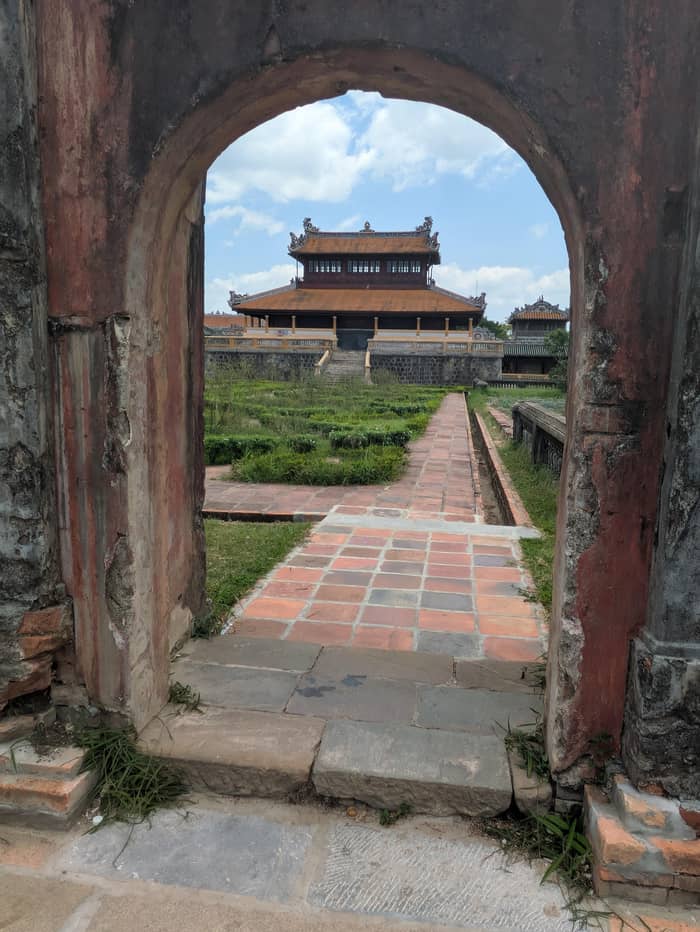
12.5 hours
Train, citadel and a tomb
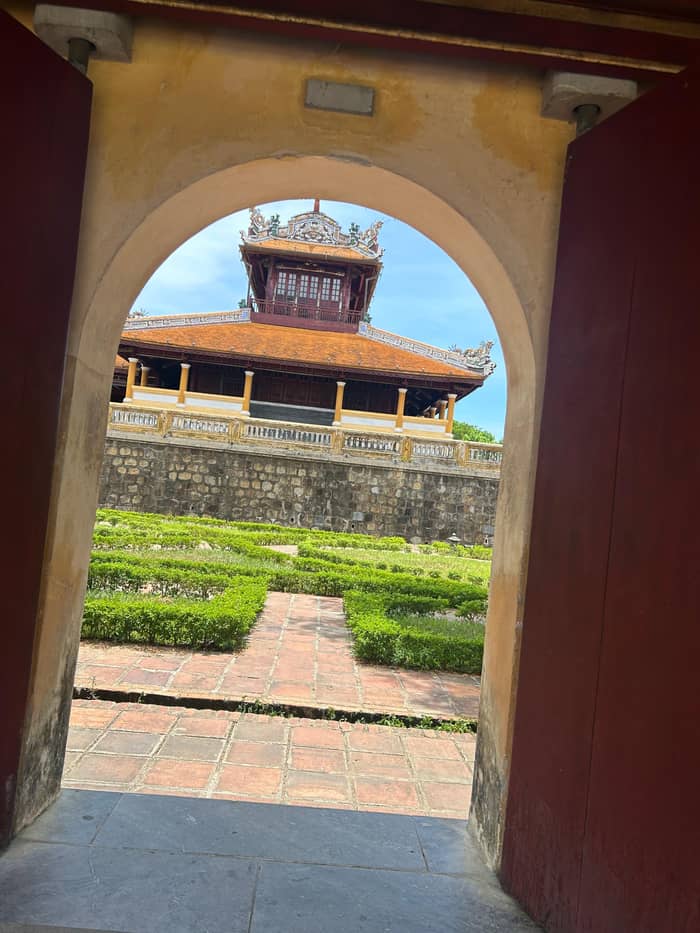
4 to 8 hours
Citadel, pagoda and tombs
The emperors planned their tombs while they ruled, so the tombs are a second history of the court. The Gia Long mausoleum took 6 years to build, from 1814 to 1820, and the tourism authority says it is the oldest of the Hue tombs.32,10 Minh Mang's tomb, finished in 1843, expresses military strength and cultural conservatism, while the Tu Duc tomb was finished before his death and was a place where he wrote poetry and fished in the lake.11,33
The later emperors tell a sadder story. The authority writes that the Duc Duc reign lasted 3 days before he was deposed and sentenced to death, and that Dong Khanh oversaw a Vietnam under absolute French control, reigning just 3 years before he died in his early twenties.18,19 The tomb of Dong Khanh is the first example of blended styles in Hue, with a marked European gothic influence.34 The tombs record political change as clearly as any chronicle.
The twentieth century arrives in stone at An Dinh Palace. The city portal says An Dinh dates from 1917, the Khai Dinh reign, and stands on the An Cuu River, and that it is considered a typical representative of the neo-classical Vietnamese architectural style, with frescoes of high artistic value.12,35 The Khai Dinh tomb that stands on a hill of climbing platforms shows the same appetite for Eastern and Western mixes.36 Pair the palace with the tomb on a day and the dynasty's final decades explain themselves.
The modern history of the site begins with a listing. The city portal dates the UNESCO recognition of the Hue Imperial Citadel as World Cultural Heritage to 1993.4 The Hue Monuments Conservation Center that led the Thai Hoa restoration is also the body behind the online ticket site for the monuments.5,29 The portal splits the complex into 3 zones, namely Citadel, Imperial City and Purple Forbidden City, and puts the Imperial and Forbidden Purple City parts at about 36 hectares.37,38
Conservation is slow and visible. The portal says the Thai Hoa works cover strengthening the foundations, new roof tiles, enamelwork and gold lacquer, with artisans racing a November deadline.39 Alongside the monuments sits a new use of the waterways: a pilot electric boat tour, launched under a 5-year plan from 25 September 2025, opens the Ngu Ha River inside the citadel to visitors for the first time.40 The heritage is being lived with, as well as preserved.
The living neighborhood also carries history. Beyond the walls, princes and princesses lived in houses called Phu De. More than 100 once existed and about 50 remain, mostly in Vy Da, Gia Hoi, Kim Long, Phu Cam and Thuy Bieu.21 Each house was planned as a scaled-down citadel, a screen wall for the mountain and a shallow pool for the river.41 These houses show how the court's taste spread into the city.
Video
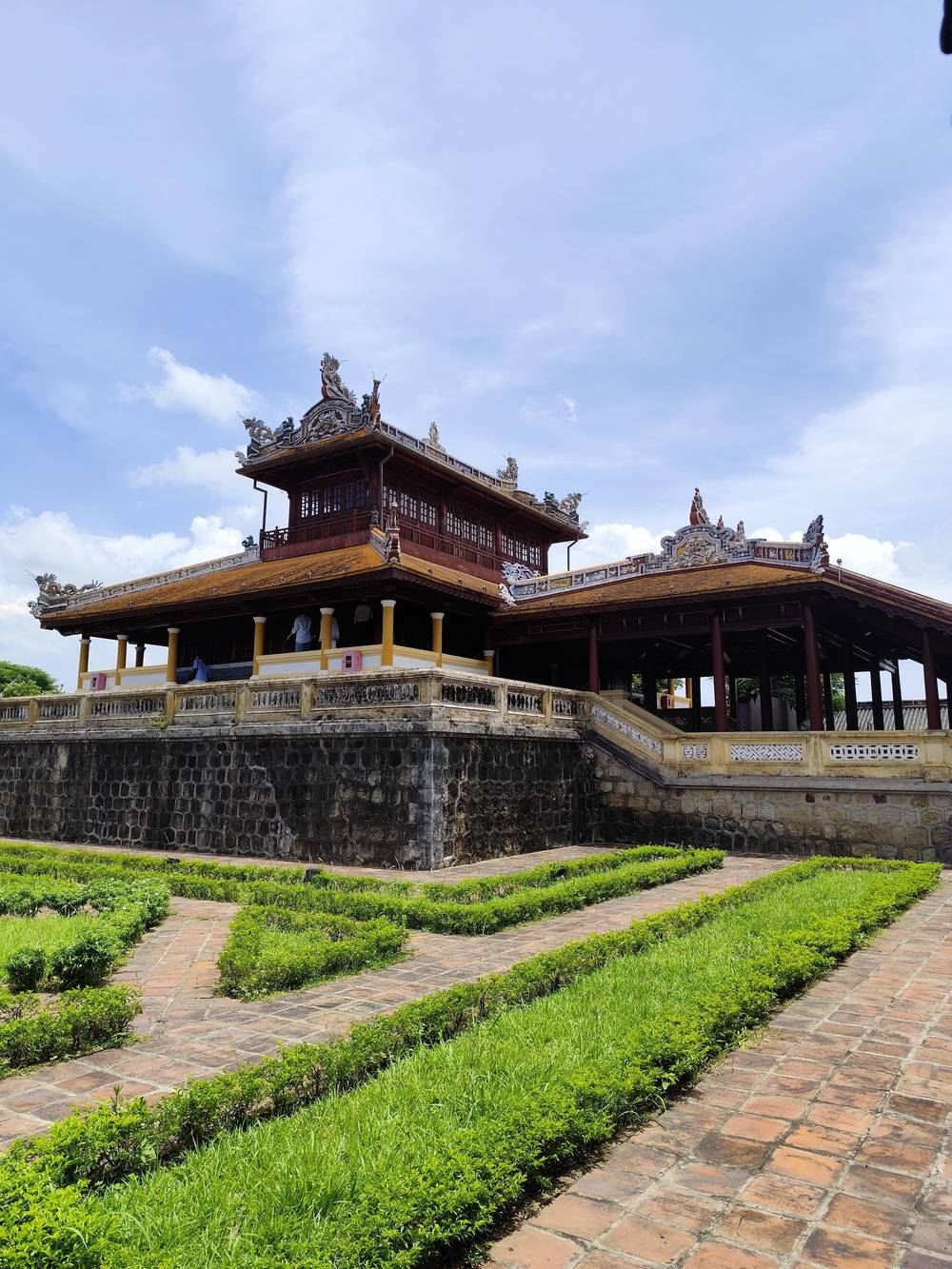
Seniworld Travel on YouTube · The video only starts loading on your tap.
He reinforced Confucian values, moved the capital to Hue from Ha Noi, began construction of the Hue Citadel,
Before you read the walls
Choose a way of visiting that suits the history you want. A walking tour of the Imperial City with a live guide lists about 2.5 hours and stops that include the Meridian gate, the throne hall, an inner palace and the royal theater, with the ticket paid separately. The Hue heritage tour from Da Nang that this site books gives the citadel 2 hours with a live guide, and then a tomb stop of 45 minutes. The tourism authority recommends taking a guide into the Imperial City.42
A guide matters because the buildings do not label themselves. Several are reconstructions or are under restoration, and a guide can say which is which. The portal's account of Thai Hoa Palace says the main objective of its restoration is to preserve the authenticity of the heritage site.43 Ask your guide specific questions: which emperor ordered this hall, when was it moved, what survived and what was rebuilt. Dates and names matter most when a person can place them in a sequence.
If you prefer to read as you walk, carry a short list of dates in your notes or on your phone. The ones worth keeping are 1805 and 1833 for the throne hall, 1836 for the urns, 1820 and 1843 for two tombs, 1917 for An Dinh and 1993 for the listing.8,9,10,11,12,4 Do not expect every sign on site to give them, and note that a construction date and a completion date can differ for the same building.
FAQ
The tourism authority says Gia Long, the first Nguyen king, moved the capital from Hanoi to Hue and began the citadel.1
The city portal says the citadel was recognized as a World Cultural Heritage that year.4
It was built in 1805 and relocated in 1833 by Minh Mang, the portal says.8
A restoration that began in 2021 at 129 billion VND is described on the city portal.5
An evening programme is listed between 19:00 and 22:00, so ask at the gate whether it is on.30
Sources
Planning a day in the Hue Imperial City? Ask a real person here.